The Ghost in the Machine: Eliminating Phantom Stock and Dead Inventory
Phantom stock and dead inventory are silent profit killers. Learn how cycle counting, lean reorder points, FIFO batch tracking, and real-time sync eliminate them for good.
The email arrives at 9:14 on a Tuesday morning. The subject line reads: "Update on your order #8841." The body, three sentences: "We're sorry, but one of the items in your order is no longer available. We have cancelled your order and issued a full refund. We apologize for the inconvenience."
The customer had placed that order two days earlier. The product page said "In Stock." They'd already told their team the supplies were on the way. Now they're on your competitor's website.
This is the moment phantom stock turns from an operational embarrassment into a business problem. The inventory system said you had units. You didn't. And the ripple from that single mismatch — the lost order, the refund processing cost, the customer you may never win back — plays out silently, across dozens of SKUs, every single week in warehouses that rely on data they can't fully trust.
The Real Cost of a Stock-Out
Industry estimates put the average e-commerce cart abandonment triggered by an out-of-stock event at 3–4x the value of the single lost sale. You're not just losing today's transaction — you're losing customer lifetime value. A B2B buyer who gets cancelled on once will test another supplier for the next order. If that supplier delivers, you may never see them again.
The compounding damage doesn't stop there. Marketplaces like Shopee, Lazada, and Tiki penalize sellers for cancellation rates. High cancellation rates depress your ranking in search results, which depresses discovery, which depresses revenue. A phantom stock problem that starts in the warehouse ends in your marketing funnel.
On the other side of the same coin is dead stock — inventory that arrived, never sold, and is now occupying shelf space and warehouse square footage you're paying for. If a SKU hasn't moved in 180 days, it isn't inventory anymore. It's a loan to yourself at zero interest, secured by products you may eventually have to liquidate at a loss.
How Ghosts Are Born
Phantom stock doesn't materialize out of nowhere. It accumulates through predictable failure modes, most of which are invisible until a customer order exposes them:
- Multi-channel sales without real-time sync. A unit sells on your Shopee storefront. Your inventory system doesn't know — or finds out 30 minutes later through a batch update. In that window, the same unit gets allocated to a direct order. You now have one product and two committed customers.
- Returns that don't make it back to stock. A return arrives, it's physically in the building, but it hasn't been inspected, restocked, or logged. The system still shows it as sold. The unit sits in a returns bin for two weeks and nobody knows it's available.
- Damaged goods that aren't written off. Twelve units got wet in a delivery. Six were discarded. Someone forgot to record the adjustment. Your system still shows twelve sellable units.
- Manual count errors compounding over time. Each small error is survivable. Six months of small errors produce a stock count that's structurally wrong — off by 5–15% on your highest-velocity SKUs.
None of these causes require negligence. They require only a system that can't capture reality fast enough to stay synchronized with it.
The Safety Stock Trap
The standard response to phantom stock anxiety is to over-order. If you can't trust your numbers, you carry more buffer. This solves the stock-out problem by creating a dead stock problem. Both destroy profit. They just do it through different mechanisms.
The leaner approach is calculating a reorder point based on actual data rather than fear. The formula is simple:
Reorder Point = (Average Daily Usage × Supplier Lead Time) + Safety Stock
Safety Stock = Z-score × σ(demand) × √(Lead Time)
For most SMBs: Safety Stock ≈ 1.65 × daily demand std. deviation × √(lead time in days) — a 95% service level without a statistics degree.
The important word in that formula is actual. Average daily usage calculated from real transaction history, not intuition. Supplier lead time measured from purchase orders, not vendor promises. When your reorder point is grounded in clean data, you order exactly what the math requires — no more safety-buffer hoarding, no more panicked emergency restocks at double the unit cost.
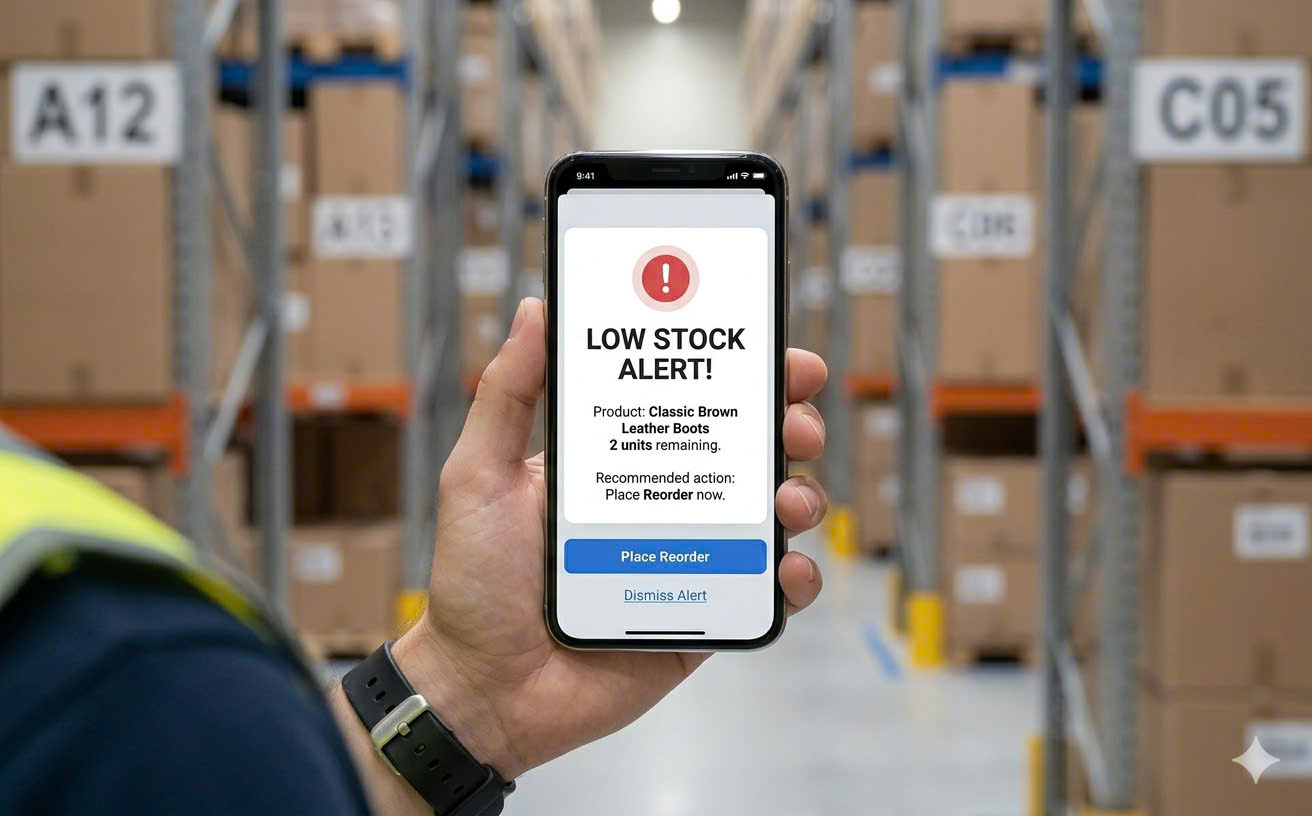
Khoai calculates your reorder velocity automatically. Rather than exporting transaction history into a spreadsheet and running the formula manually every month, Khoai surfaces live reorder status per SKU — flagging items approaching their reorder point before they breach it. The system knows your supplier lead times, tracks your rolling daily usage, and pushes an alert the moment the math says “order now.” You set the parameters once. The vigilance is continuous.
The Lead-Time Gap: Inventory in Transit Is Not On Your Shelf
One of the most overlooked contributors to phantom stock is in-transit inventory — units you've ordered from a supplier and paid for, but which haven't arrived yet. Many inventory systems count this stock as “available.” It isn't. A customer order cannot be fulfilled from a container that's still two days from the port.
The lead-time gap is the window between when a purchase order is raised and when the goods are physically checked into your warehouse and available to pick. During that window, your visible stock is a fiction. Anything you oversell against in-transit inventory is a cancellation waiting to happen.
The fix is treating in-transit stock as a separate bucket in your inventory system — not zero, not available, but specifically “incoming, due {date}. ” A platform that distinguishes between on-hand, committed, and incoming gives you a realistic picture of what you can actually promise a customer right now.
Cycle Counting: The End of the Annual Shutdown
Most warehouse operators run one inventory count per year. The warehouse stops. Every person on shift counts. It takes two days, costs a week of disruption, and produces a snapshot that's technically accurate on the day of the count and increasingly stale every day afterward.
Cycle counting inverts this logic. Instead of one massive count per year, you count a small section every day. The warehouse never stops. The data is perpetually fresh. The annual shock is replaced by continuous calibration.
How to Structure a Cycle Count Program
- Class A items (top 20% by revenue or velocity): Count weekly. These are your highest-risk phantom stock candidates because they move fastest and are most likely to be oversold.
- Class B items (mid-tier): Count monthly. Enough movement to drift; frequent enough to catch errors before they cascade.
- Class C items (slow movers): Count quarterly. Low velocity means low drift risk. Quarterly is sufficient to catch and correct errors before they produce dead stock surprises at year-end.
A warehouse with 600 SKUs running a proper cycle count program touches every item in the building roughly 4–6 times per year — versus once with the traditional model. The difference in data confidence is not incremental. It's structural.

The Expiration Race: FIFO and the Dead Stock Clock
For retail, food service, cosmetics, and FMCG — any category with a shelf life or sell-by date — phantom stock has a second dimension: age. The stock exists. It's counted correctly. But it's expired, or close enough that no customer will accept it.
The standard countermeasure is FIFO (First In, First Out) — the practice of always picking and shipping the oldest batch first. In theory, FIFO is simple. In practice, without batch tracking at the system level, it relies entirely on warehouse staff discipline to rotate product correctly on every single pick. That discipline erodes. New stock gets shelved in front of old. The oldest product gradually migrates to the back of the rack, then to the expiration bin, then to a write-off.
Batch tracking closes this loop. When every unit is logged with a batch number and an expiry date at the point of receipt, your system can enforce FIFO automatically — sequencing pick lists so that the oldest batch is always the first one out. Staff don't have to remember. The picking order makes the right choice the default.
Beyond expiry management, batch-level visibility is what turns a product recall from an operational catastrophe into a ten-minute task. You know exactly which orders received the affected batch. You contact those customers directly. You contain the exposure before it scales.
The Fix: Real-Time Sync Across Every Channel
Every problem described in this article shares a common root: a gap between physical reality and the number in your system. Phantom stock is that gap applied to availability. Dead stock is that gap applied to demand forecasting. Lead-time confusion is that gap applied to inbound logistics. FIFO failures are that gap applied to picking sequences.
Spreadsheets cannot close these gaps — not because they're poorly designed, but because they're fundamentally passive. A spreadsheet doesn't know when a Shopify sale happens. It doesn't update when a return lands on the dock. It doesn't alert you when a batch is approaching expiry. It sits, static, waiting for a human to find the time to update it. And in a warehouse running 200 picks a day, that human is never not busy.
Real-time sync means every transaction — every sale, receipt, return, adjustment, and transfer — flows immediately into a single authoritative record. There is no version of the truth that's five minutes behind. There is no “let me check the sheet” uncertainty. When a customer asks if something is in stock, the answer your team gives is the same answer the warehouse floor would give if you walked out and looked.
That alignment — between what the system says and what the physical world contains — is what turns inventory management from a liability into a competitive asset. Businesses that trust their numbers move faster, carry less buffer, oversell less, and lose fewer customers to the kind of cancellation email that opened this article.
Phantom stock isn't a warehouse problem. It's a data problem. And data problems have data solutions.
Know your real stock count, right now.
Khoai gives you a unified, real-time view of on-hand, committed, and incoming inventory across every channel and location — so the next stock-out email never has to be written.
Start free with Khoai →