The Spreadsheet Trap: What Your Inventory System Is Costing You Right Now
Ghost stock, data fragmentation, and zero real-time visibility — the hidden costs of running warehouse operations on spreadsheets, and how modern platforms eliminate them.
Picture this: It's 11 PM on a Friday. Your best wholesale client just placed a $4,200 rush order for 80 units of your top-selling SKU. Your spreadsheet says you have 94 in stock. Your warehouse team shows up Saturday morning, scans the shelves, and finds 12.
The remaining 82 units were sold two weeks ago. Someone updated the wrong column. The cell formula was off by a row. The order can't be fulfilled. Your client calls a competitor.
That scenario has a name in logistics: ghost stock. And if you're running your inventory on spreadsheets, it's not a matter of if it happens to you — it's a matter of when it happens again.
The 3 Dangers Hiding Inside Your Spreadsheet
1. Scalability Bottlenecks
A spreadsheet is a document. It was designed for analysis, not operations. When your business was moving 200 SKUs across one location, it was serviceable. Now you're managing 800 SKUs, two warehouses, seasonal demand spikes, and a growing e-commerce channel — and that same document is being emailed back and forth, version-controlled by filename (inventory_FINAL_v3_REAL.xlsx), and edited simultaneously by people who have no idea they're overwriting each other's entries.
The bottleneck isn't your team. It's the tool. Every new product line, every new storage location, every new sales channel adds compounding fragility to a system that was never designed to scale. The hours your warehouse manager spends reconciling counts at month-end aren't a people problem. They're a systems problem.
Businesses that grow beyond a certain threshold don't fail because of bad products or poor customer service. They fail because their operational infrastructure collapses under the weight of its own complexity.
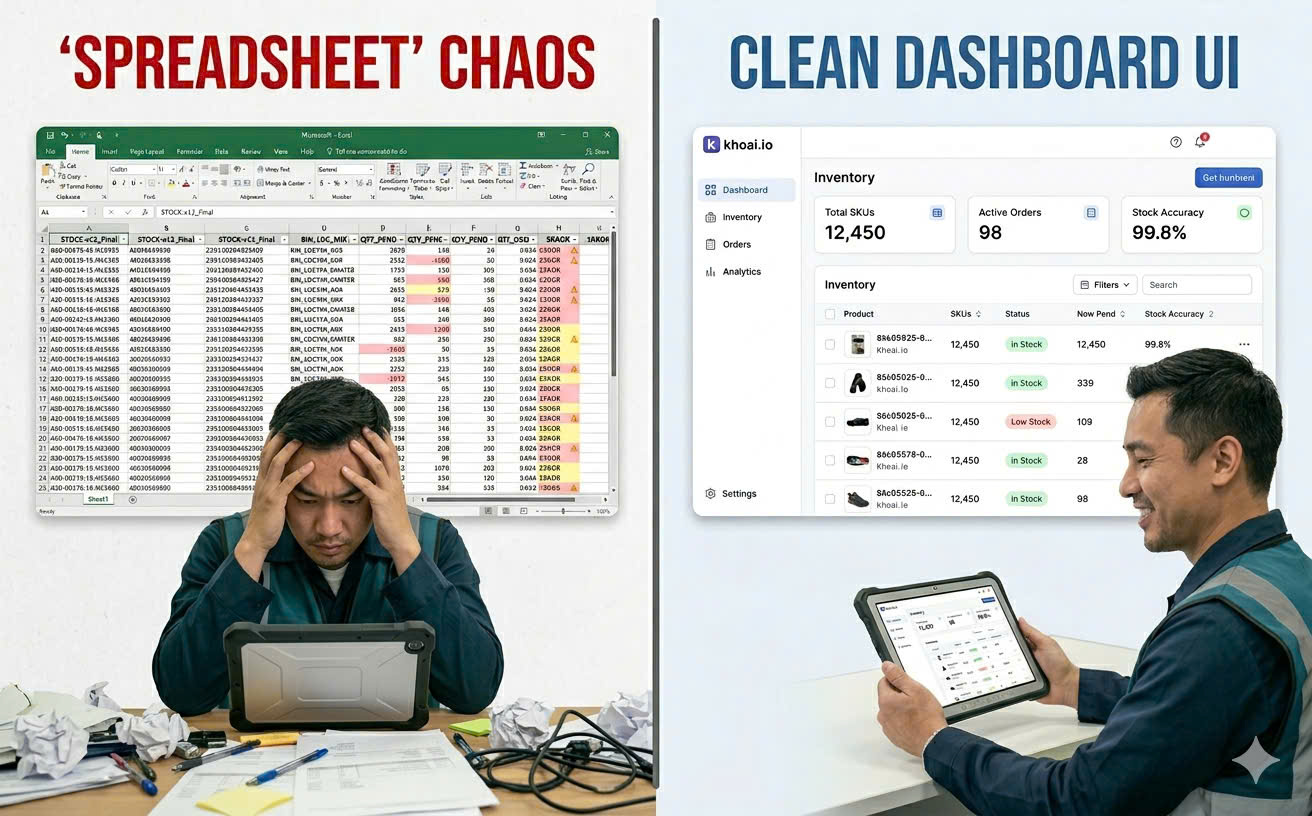
2. Lack of Real-Time Visibility
When a customer, a sales rep, and a warehouse picker all need to know stock levels at the same time, your spreadsheet gives each of them a different answer — depending on when it was last saved and who has the current version open.
Real-time visibility isn't a luxury for enterprise retailers. It's the baseline expectation of modern commerce. A customer who places an order expects it to be accurate. A sales rep quoting lead times needs confidence, not educated guesses. A warehouse manager allocating stock across locations needs a live count, not yesterday's tally.
The absence of real-time data doesn't just create internal confusion — it erodes the one thing your brand is built on: reliability. Every unfulfilled promise traces back to a data gap, and data gaps are the natural habitat of the spreadsheet.
This is precisely the problem Khoai was built to eliminate. Rather than relying on scheduled syncs or manual refresh cycles, Khoai's architecture is event-driven at its core — meaning every inventory movement broadcasts an update the instant it occurs. A pick confirmation in the warehouse triggers an immediate stock decrement visible to your sales team. A goods receipt at one location reflects across all connected branches before the pallet hits the floor. There's no polling delay, no “please refresh the page,” no version mismatch between what the floor sees and what the office sees. Every stakeholder — from the warehouse picker to the operations director — is looking at the same live state of inventory at the same moment. When your visibility is built on events rather than intervals, ghost stock doesn't get a window to exist.
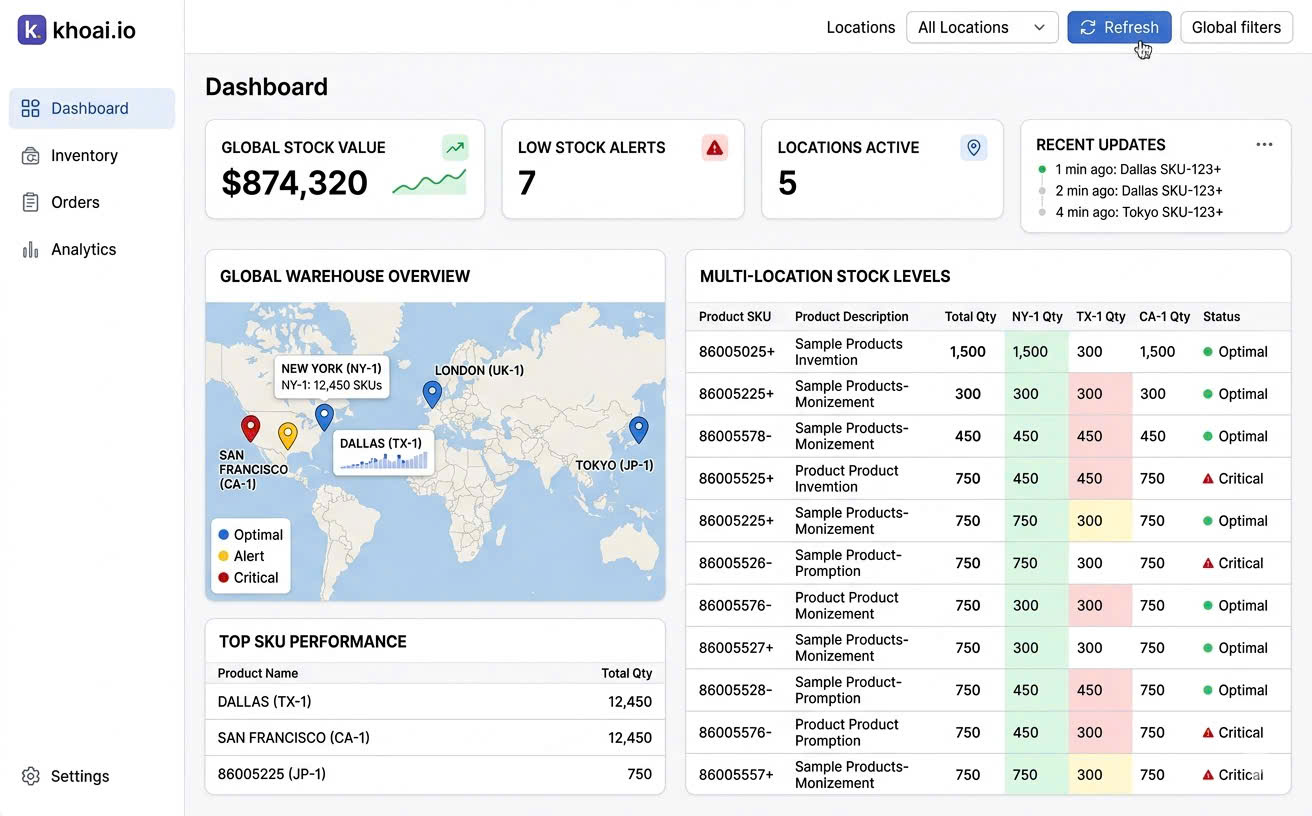
3. Data Fragmentation
Your inventory data doesn't live in one place. It lives in the purchase order email thread, the receiving log on the dock clipboard, the spreadsheet on the operations manager's desktop, the verbal update from the night-shift team, and the invoice your accountant is reconciling at quarter-end.
This fragmentation is invisible until it isn't. A supplier ships a partial order. It gets logged on the clipboard but not in the spreadsheet. A reorder triggers automatically based on the spreadsheet figure. You receive duplicate stock you don't have room for while a different SKU sits at zero. Your accountant flags the discrepancy six weeks later.
Fragmented data means no single person in your organization has an accurate, complete picture of your inventory at any given moment. Decisions get made on partial information. Corrections happen reactively. Margins erode quietly.
The Move to a Specialized Logistics Platform
Modern inventory management systems — built on robust, high-performance server infrastructure — operate on a fundamentally different principle: a single source of truth.
Every transaction — a receipt, a pick, a transfer between locations, a customer return — is recorded once, instantly reflected everywhere, and accessible to every authorized stakeholder in real time. There is no version control problem because there is only one version. There is no reconciliation lag because the data is current by definition.
- Multi-location syncing means your warehouse in the north and your fulfillment hub in the south are looking at the same numbers simultaneously.
- Role-based access means your warehouse pickers, your buyers, and your finance team each see exactly what they need — nothing more, nothing less.
- Audit trails mean that when something does go wrong, you don't spend three days figuring out what happened. You know in three minutes.
This isn't about replacing your team's judgment. It's about giving your team accurate information so their judgment is worth something.
The human error factor doesn't disappear when you switch platforms — but its blast radius shrinks dramatically. A typo in a spreadsheet silently corrupts downstream decisions for weeks. A data entry error in a proper inventory system triggers a validation flag immediately and gets corrected before it ships.
The Cost of Waiting
The real question isn't whether you can afford to modernize your inventory operations. It's whether you can afford the ongoing cost of not doing so: the ghost stock incidents, the emergency reorders, the reconciliation hours, the client trust you're quietly spending down every time a fulfillment goes wrong.
The warehouse managers who thrive at scale are the ones who stopped treating their inventory system as a record-keeping convenience and started treating it as operational infrastructure.
Your spreadsheet got you here. It won't get you where you're going.
Ready to close the gap?
See what a clean, real-time inventory system looks like for your operation. The conversation starts with one question: when did you last have complete confidence in your stock count?
Start free with Khoai →